Ethics and Keeping Consumer Information Private

Image source; https://www.forbes.com/sites/forrester/2018/11/14/ethics-and-consumer-action-will-transform-privacy/

Have you ever wondered whether your personal information is safe and secure once you provide it to online businesses? I know I have when I signed up to Facebook for the first time back in 2009. To think so much information could potentially be one click away scares so many people, which makes it an important factor for businesses to assure consumers and users that their private information is secure. Considering the amount of fake accounts and “bots” that are present across all social media platforms it’s really no wonder people are feeling unsafe. In fact, around 15% of Twitter’s 48 million active users are automated accounts and Facebook had reported that they had twice as many fake accounts as they anticipated, which sits at 60 million automated accounts (CNBC,2017). So what is privacy? It relates to principles of human dignity, human uniqueness, the importance of solitude, and has historically been described as ‘the right to be left alone’ (CPDP, 2018). Furthermore, personal information is also an important factor businesses must consider. It can be defined as; information or an opinion (including information or an opinion forming part of a database), whether true or not, and whether recorded in a material form or not, about an individual whose identity is apparent, or can reasonably be ascertained, from the information or opinion (Commission, 2019). Privacy is a huge factor and consideration in today’s society. We see the likes of many businesses almost cross the line with privacy with various technologies that are evolving around us. So many people have mixed emotions which is demonstrated in the chart below. It is clear to see that many people are feeling uncomfortable or at least somewhat uncomfortable, which is a concerning figure.

Image source;
Office of the Australian Information Commissioner (2017) Australian Community Attitudes to Privacy Survey

So where is the line when it comes to privacy and personal data? Many companies have utilised their access to personal information to perfection, like Google Home technologies, or social networking platforms like Facebook that have access to information, which can then be used to advertise, or suggest various pages you should follow/like. We as consumers provide endless amounts of data whether it be personal or what pages we visit online (Forbes, 2018). Companies also utilise technologies such as cookies. When you visit a site that uses cookies for a first time, the cookie is downloaded onto your device. The next time you visit that site, your device will check to see if it has that particular cookie. The site then knows that you have visited before and can then tailor what appears on your screen (BBC,2014).Whether they are viewed as good or bad can be a personal opinion. Broken down they can have both good and bad impacts. The negatives include that they can be a breach of security, privacy and secrecy. Some users feel unsafe when they consider that cookies can store your information and can be used for tracking. The positives include convenience, personalisation and easy to turn on or off (Liu, 2012). I know I often come across sites that will attempt to use cookies, and I will not always allow them. Do you feel safe when allowing cookies or does it make you feel uneasy knowing the negatives attached to them?

image source; https://www.internetmarketinginc.com/blog/the-pros-and-cons-of-cookies-a-google-story/

For companies who do cross that line with privacy or are unethical about their practices, their can be short and long term consequences. These can consist of loss of jobs, organisations can lose their credibility which in the long term can result in financial loss. Companies need to ensure their practices are ethical, especially when it involves their consumer privacy and security (Bowes,2016). I can understand why people feel uneasy regarding their security, do you? Or are you comfortable with where our technology is sitting and how much of our personal life some companies have access to. Let me know your thoughts below. Thanks for reading this weeks blog. Look forward to hearing your thoughts on this weeks topic.

Marketers use of Search Engines and Analytics

image source: http://i-maxinfotech.com/images/Search-engine-marketing.jpg

How often do you open your browser and head to a search engine to find information or images about something that interests you? And to what search engine would you generally head to first? There have been countless occasions where I have jumped onto my iPhone or Laptop and automatically head straight to google as my source of search engine. Like me, many others use Google as their primary search engine, with clear dominance over their competition. A companies choice of search engine (for many this would be Google) and presence is crucial in determining the success of their Search Engine Marketing campaigns (SEM). So what is SEM? Simply it is a digital marketing strategy used to increase the visibility of a website in search engine results pages (Optimizely, 2019). There are two key SEM techniques; Search Engine Optimisation (SEO) and Pay Per Click (PPC). SEO refers to the process of optimising your website to get placed higher in the organic search result listing of search engines. Over 64% of website traffic comes from the organic listings, as searchers’ eyes are drawn to these results first. However, it is not a process that happens overnight, and companies need to understand it is an ongoing process and requires technical expertise. PPC is a situation where search engines like Google offer businesses the opportunity to pay for premium advertising spaces at the top and sides of their search results (WebCentral, 2019). It could be said that it is almost impossible to achieve success as a business if they do not implement SEM strategies into their operations.

It is remarkable how dominant Google is when it comes to market share amongst its competitors. As of April 2019, Google owned 92.42% of market share, with Bing coming a very distant second with 2.61% (Statcounter, 2019). I think it’s very obvious why companies would choose to implement SEM strategies through Google as opposed to its competitors. To fully understand SEO, companies should understand the key phrase analysis, which in basic terms is determining what their customers are searching. This includes factors like comparison/quality of the phrase, adjectives, intended use, product type, vendor, location and action request (Google, 2019). Companies need to consider how many competitors would be attempting a similar strategy, so their key word analysis needs to be thoroughly done to ensure maximum results. All in attempt to be that first page when customers search particular things, amongst the billions of other results that could potentially pop up. Moreover, the Black hat vs white hat theory explains the different forms of SEO approaches. The black hat approach refers to techniques and strategies used to get higher search rankings, and breaking search engine rules, whilst the white hat strategy refers to the use of techniques and strategies that target a human audience opposed to a search engine (Unamo, 2019). The black hat approach contains hidden content including; comment tags, small font/white text on white background. Also includes Meta keyword stuffing, doorway pages and link farming. In contrast the white hat technique includes; quality content, appropriate use of titles and meta data, keyword research, use keywords across all elements of your pages and quality inbound links (Valentino, 2019). Which approach do you think would be more beneficial generally speaking?

image source: https://www.lynchpin.com/marketing-analytics/

To determine whether your e-marketing strategies require improvement, companies use marketing analytics. This involves reviewing traffic volume, referrals, clickstreams, online research data, customer satisfaction surveys, leads and sales. The impact marketing analytics can have on a business are that firms attain favourable and sustainable performance outcomes and if competition is high, and consumer preferences are rapidly changing, analytics become even more important (Germann, 2013).

What search engine do you choose to use? Do you think it is more beneficial for a business to attempt the PPC strategy? Let me know your thoughts below. Thank you, for reading this weeks blog.

Big Data & the Internet of Things… How is it affecting your life?

image source; https://datafloq.com/read/7-trends-of-internet-of-things-in-2017/2530

Technology is advancing rapidly in front of our very own eyes. As we watch the advancements of phones, cars and many other things exceed what our expectations were 10 years ago, we can only imagine what the next ‘big thing’ is. An advancement I have found intriguing is the concept of “Internet of Things’ (IoT) whereby you can connect any device including mobile phones, coffee machines, headphones, lamps and almost anything else you can think of, with an on and off switch to the internet (Morgan,2014). This could be of great value to us as we live our ordinary lives. For instance on our way to work, our car could already be connected to a GPS that has analysed the best route to take, with minimal traffic. But this concept doesn’t just benefit individuals, it can have extreme value for cities, where it can connect to things like transportation networks, which could eventuate into improvements with energy use and efficiency. It is hard to imagine that something so well developed has still been left open for future opportunities which leaves us wondering where we could be and how it will impact our lives in the near future.

image source; https://www.i-scoop.eu/smart-home-home-automation/

So how have we utilised such technological advancements to effectively ‘improve’ our lives? A company that is attempting to enhance the way we live is Nest. Today, lots of brands that we already use can connect to Nest, such as your Philips Hue lights and Wemo switches. An example with how Nest operates is when the music may be too loud to hear a smoke alarm, considering it is all connected to Nest it can turn the music down to help gain your attention when it detects smoke or carbon monoxide. And if that doesn’t interest you, Nest can also turn your lights or heater/air conditioning systems on using sensors that detect motion when someone enters the room. Also, in situations that may require action, Nest can turn on sprinklers outside if they detect smoke. Those days of flicking a light switch on and off manually are over, as we watch technology transform the way we live before our very own eyes (Nest, 2019).

image source; https://www.weetechsolution.com/blog/nest-launches-smart-home-product

Our daily activities leave a digital “footprint” whereby businesses can attempt to watch general traffic online. Big Data can be defined as the large volume of data- both structured and unstructured- that inundates a business on a day-to-day basis. Keeping in mind it’s not the amount of data that’s important, its what organisations do with the data that matters, which if analysed correctly can lead to better decisions and strategic business moves. So who uses big data? There are more industries than not using big data as it proves to be such an effective marketing tool. Industries like Banking, education, government, health care, manufacturing and retail all utilise Big Data in their own ways to benefit them. For instance, in the retail industry, customer relationship building is critical their operations. Retailers need to know the best way to market to customers, the most effective way to handle transactions, and the most strategic way to bring back lapsed business. Such accessibility provides many benefits for companies by understanding how consumers are using their digital platforms like social media, streaming data and publicly available sources, and if analysed correctly can lead to a very successful marketing campaign (SAS, 2019). A company that has used Big Data to great success is Netflix. Most people I know have a Netflix account, however all differ in slight ways as to watch they stream. Netflix develop trends based on our viewing habits to add and delete certain films to maximise the benefits for us as viewers to see more movies that interest us according to region, but also to maintain the amount of people subscribed. Moreover, they also use data to commission original programming content that appeals globally as well as purchasing the rights to films and boxsets that they know will perform well with certain audiences (O’Neill, 2016).

image source; https://www.icas.com/ca-today-news/10-companies-using-big-data

It’s interesting to think where we are headed in regards to such technology advancements, and the ways a company can utilise such activity to enhance their campaigns. Can you think of any opportunities that you can see developing in the near future regarding IoT, or think of a company that has used Big Data to great success? Let me know your thoughts below. Thank you again for reading this weeks blog posts. Look forward to hearing your thoughts.

The Importance of Mobile Marketing

image source; https://komarketing.com/images/2016/05/Mobile-Marketing-Vector.jpg

How often do you find yourself using your mobile device whether it be in an app, a website or on social media? Of that usage how often do advertisements are other forms of marketing bombard your mobile screen? Such exposure and technology that is accessible makes mobile marketing such an effective tool for spreading a company’s promotions and messages. One can simply define mobile marketing as “any marketing activity conducted through a ubiquitous network to which consumers are constantly connected using a personal mobile device” (Kaplan, 2014). It is more common than not in today’s society to view advertisements on your phone several times a day. Free game apps often contain various ads where we have no choice but to watch in order to continue playing, and on every social media platform there are ads swarming the feed. Other mobile marketing tools include simple mobile ads, mobile coupons, mobile websites, location based mobile marketing and mobile payments, each effective in different ways (Kaplan,2012).

Image source: http://bootcampdigital.com/nfs/c03/h02/mnt/52724/domains/bootcampdigital.com/html/wp-content/uploads/2014/05/Mobile-Marketing-Stats-20141.jpg

Without much thought behind the differences in mobile marketing, as many people only see ads as ads and maybe not the technical aspect of them which makes it difficult to understand that each technique can be specifically categorised. There are four main classifications of mobile marketing applications based off two concepts revolving around the degree of consumer knowledge and the trigger of communications. More specifically they determine whether we can be classified as “Victims” for example AT&T sending text messages to 75 million customers suggesting they should use their AT&T phone to vote for American idol. “Patrons” are another classification , which can be related to the Britney Spears example whereby fans can receive f0r $2.99 a month updates via text message of her life on tour, allowing customers more choice in following up on the offer. “Strangers” with another industry example being that Toyota merged with fox broadcasting to insert 10-second commercials into 26 short mobile movies for the TV show prison break, and finally “Groupies”. Calvin Klein used Quick Response codes on billboards in New York to allow users to pull an exclusive 40-second commercial. In continuation there are also classifications of mobile social media applications which can be described as via they table below (Kaplan, 2012).

image source: Kaplan, Andreas M. (2012). “If you love something, let it go mobile: Mobile marketing and mobile
social media 4×4. Business Horizons, Vol. 55(2), 129-139

When I think of mobile marketing I immediately think of companies utilising social media platforms to communicate their marketing campaigns. However, there are other platforms in which well established companies have used and have achieved great success from. For instance, IKEA utilised the capabilities of mobile by creating an app, which transformed its catalogue into an interactive platform. It also allowed you to place virtual products in a room and such creative led to 6.2 million installs, being the number 1 downloaded marketing app for a brand (Allen, 2016). Another example of a company implementing mobile marketing is the Ford Motor Company. On release of their new vehicles Escape and Taurus, they asked those consumers who wanted to find out more to text the word ‘FORD’ to 63611, who were then contacted again to inquire which vehicle they were interested in and were required to provide their names and local zip codes. This info went to local ford dealerships where follow up calls were made which resulted in a 15.4% conversion rate (Creative, 2019)

image source: https://www.dailydot.com/wp-content/uploads/77d/39/e080f9528d416c13-2048×1024.png

There are several components companies need to understand when attempting their mobile marketing campaigns. These consist of knowing your customer and anticipate their needs, develop a strong SEO strategy, meaning companies should use tools such as Google Keyword Planner to understand what customers are searching in regards to keywords or phrases. A company should then embed these in their webpages to maximise the chance of their website being found when a customer needs a solution to a problem. Finally, include paid ads in their marketing stack which is a great way to ensure that you are there when your prospects need you. In addition to these three components, others factors include reaching customers at the right time, find opportunities to teach, make the content easy to consume, and being relevant. By following such guidance companies should find success in their campaigns (Veyna, 2018)

Can you think of or remember any mobile marketing campaigns used by companies that led to great success or perhaps failure? Feel free to share your thoughts below and thanks again for reading this weeks blog post.

The Affects ‘Spreading the Word’ Can Have on Marketing

Image source: http://www.greenberg-art.com/New%20illos/Spread%20Of%20Ideas%20illo.jpg

Have you ever seen something on social media that interests you so much that you feel the need to tell someone about it? Or have you seen something that might interest another and proceed to share it to them? Now think just how many people have seen the same post and imagine the benefits obtained by a company in regards to exposure. This is the power of Word-of-Mouth which is a technique companies would hope naturally occurs as they attempt to create viral marketing, which in simple terms is the receiving of information that then gets passed on from one consumer to a number of others (Rakic, 2014). Word of Mouth is the primary factor behind 20-50% of all purchasing decisions and is attempted to create something of interest to an audience. This technique appears more trustworthy and thus is not a form of advertising but still needs to be targeted towards the right audience at the right time. Word of Mouth can be created through conversation (face to face), communications (messages or email), media (through creation of a blog or video post), social media (sharing content and posting information), communities (topic based electronic boards) and reviews (of products or services) (Spacey, 2017)

image source:https://www.osiaffiliate.com/blog/how-to-word-of-mouth-marketing/

As a member of several different brands rewards programs, one being Woolworths Everyday Rewards, I receive emails regularly with updates that are personalised to my shopping experiences. Email is a useful tool as it is easy to send and a large amount of people still receive and check them, especially those emails that interest them which leads me to my question…. how do marketers capture interest on first glance that then encourages users to continuing reading the email? According to Jonah Berger there are ‘6 STEPPS’ for success applied to email marketing. These are: social currency which is sharable information which holds social currency and makes them look good to those around them. Moreover, triggers, which includes something that is easy to remember, ensuring it stays top of the mind. They also tend to use Emotion as it is more likely to be shared if it includes an emotional component. The fourth step is public, which is on the basis of the concept “built to show, built to grow”. Marketers should also include practical value which in other words means relevance. Finally, emails can include stories to pass on knowledge or share something through these means that may be of value to the reader (Trivunovic, 2013). By using some or all of these STEPPS, it will go a long way in spreading the message businesses are attempting to expose.

Observing my latest email based on this weeks specials at Woolworths, we can identify some of the ‘STEPPS’ mentioned by Jonah Berger. Despite not all steps being necessary it is still appropriate to include some, depending on what you are advertising. In this case there is evidence of social currency as it relates to my past sales, which I will be able to tell others I know have an interest in similar products. Furthermore, with a noticeable title of “Your Personalised Sales” it can act as a trigger point, relating to something directly to myself that I can remember. Because it is based of past sales it does include practical value, as it shows relevance to me as a shopper. This email does not include emotion or stories, however, as mentioned may not be necessary to Woolworths marketing campaign in this case.

Thank you again for reading my blog post, but before you leave, consider thinking about just how many of those ‘STEPPS’ should be included as a minimum in a company’s marketing campaign in order to achieve success. Feel free to leave your thoughts in the comment section below.

The Importance of Social Media for Businesses in the 21st Century

The growth of social media over the last decade and more has been phenomenal. Take a look back to 2009, where Facebook was already a huge platform for social media. In January of that year the social media application had registered more than 175 million users, and at the same time, every minute, 10 hours of content were uploaded to YouTube (Kaplan & Haenlein, 2010). No wonder so many businesses modernised their marketing approach and sought these platforms when they have so many users. To put social media growth in perspective to current day, it is reported there are now over 2.3 billion monthly users of Facebook (Zephoria Digital marketing, 2019), proving an appropriate way for companies to advertise their goods and services given the dramatic rise in users.

Image source; https://www.smartinsights.com/social-media-marketing/social-media-strategy/new-global-social-media-research/

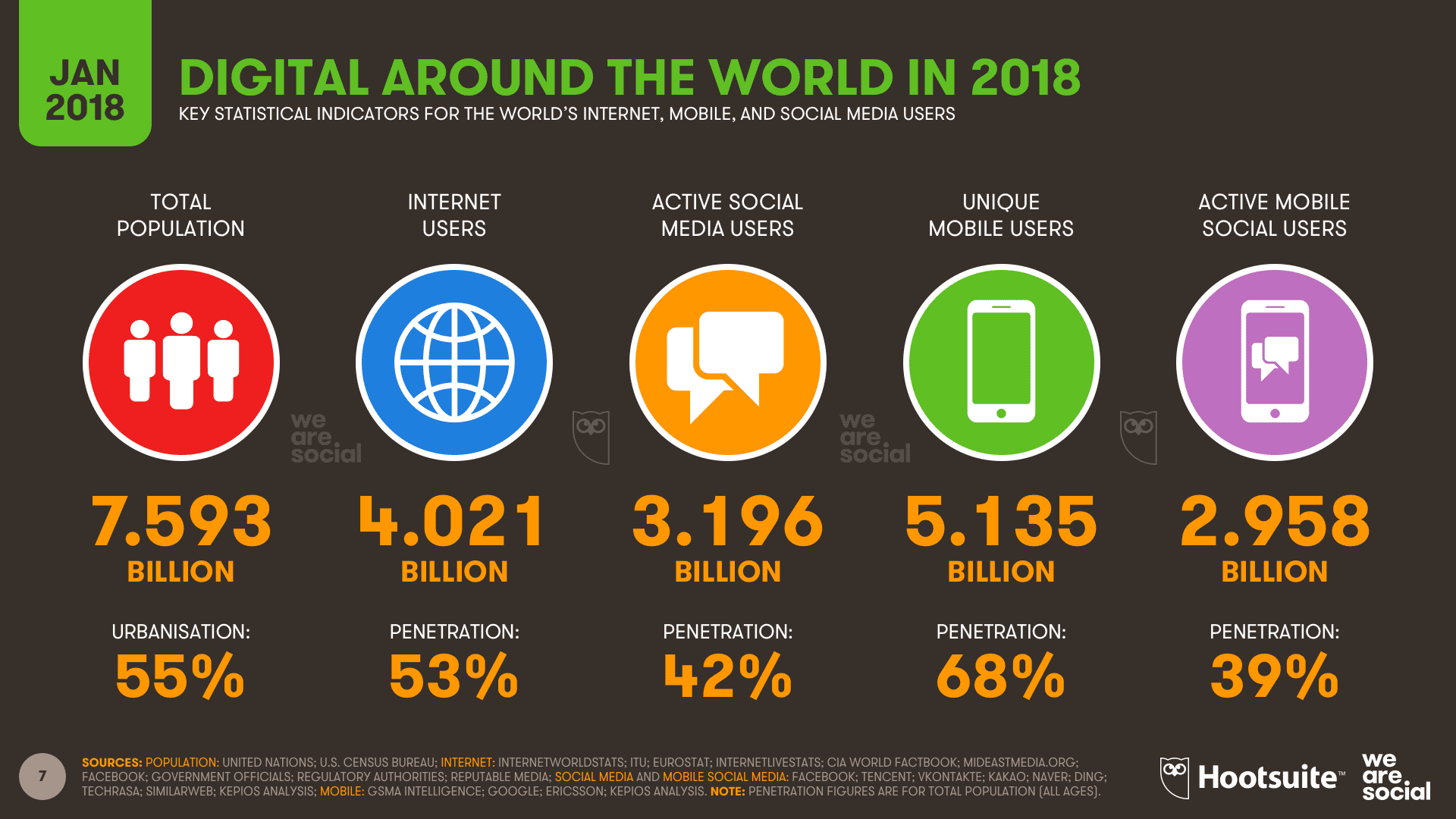
So what defines Web 2.0? According to Tim O’Reilly, “Web 2.0 is the network as a platform, spanning all connected devices; Web 2.0 applications are those that make the most of the intrinsic advantages of that platform: delivering software as a continually-updated service that gets better the more people use it…” Web 2.0 also refers to the growth of social media, which as explained above plays a crucial role in modern times in how businesses conduct their advertising. Based on the diagram above, I found it very interesting that based off last years results, the world has become heavily digital based, to the point where there are 2.9 billion social mobile users. For companies the benefits of using such platforms would be extremely high, with a larger viewer reach globally, in comparison to traditional advertising methods (Business.gov.au, 2018). Therefore, poses the question for businesses whether to use a celebrity with high followers to promote their offers or to post only via their personal page.

Image source; Instragram; @Cristiano Ronaldo
Image source: Instragram; @selenagomez

Companies who are able to promote their businesses through high profile celebrities are able to spread their promotion to a huge audience both via their own page and also the selected celebrity. In the above case, currently Cristiano Ronaldo has 157 million and Selena Gomez has 147 million followers, two of the highest profile celebrities on Instagram. For those companies who seek celebrity endorsers, it can lead to huge success. However, for those companies who attempt advertising via their own page alone, can also reap large success. for companies using social media they need to be careful about where they post, at what time and on what day based on consumer usage. It is important for businesses to be active, interesting, humble, unprofessional (fun and personal) and honest (Kaplan & Haenkin, 2010). Based on the diagram below it is interesting to see when brands are posting in comparison to when people are using social media. It is clear to see there are more people using these platforms on weekends, however companies posting more on business days.

Image source; Buddy Media, “Strategies for Effective Wall Posts: A Timeline Analysis”, Sept 2012.
http://socialmediatoday.com/gonzogonzo/1695916/content-marketing-kiss-keep-it-significant-and-shareable

The regular use of social media by people on a global scale only amplifies the importance of advertising via these platforms for companies to be successful in their marketing campaigns. It is interesting to see to what scale social media and the internet has taken over our lives and just how influential celebrities can be when promoting certain brands.

Thank you for reading my blog. I look forward to sharing more content over the coming weeks, and hearing from you via the comments below if you feel like sharing your thoughts.